Sunday, October 9, 2011

Bare Bones Backpack

Many of you have expressed concern that emergency prep is another thing on your list that you don't have the time or money for. The reality is, that you have a lot of the important items in your home already - no purchase necessary. 

 
Your TO-DO: Assemble at least a bare bones backpack.

Include:
  • Flashlight with batteries
  • A change of clothes. Generally, include a pair of long pants and a long sleeved shirt.  If you have an old jacket, include it.  Don't forget the underwear, socks, and a hat.
  • List of emergency contact info/photocopies of important documents.* At the very least, important phone numbers and ID.
  • Some bottled water and/or means to filter water. (16 oz in your pack is better than nothing in your kit, right?**)
  • Snacks, high-calorie and non-perishable 
Have on hand:
  • Water - 72 hours worth is 3 gallons/person.  You didn't think you were going to have to carry all of that in your backpack did you?**
  • Radio
  • Other emergency lighting
  • Basic first aid supplies
*Refer to the blog post - "Let me see some ID" for further details.

Do yourself a favor; do this much, just this much.

Saturday, September 24, 2011

Who you gonna call?

Let's face it, the day of memorizing phone numbers is long gone.  Cell phone contact storage has freed up space on the hard drive of our minds for, ahem, more important things (sports statistics anyone?), but how will you fare without it?

Pop Quiz:  Your phone battery is dead - or maybe only mostly dead - leaving you little time to extract phone numbers. True love won't bring your phone back to life*, so write down the numbers of 5 important people for you to contact should you experience a major earthquake. 

Pencils down.  Who was on your list?  Did you know the entire number?  Did you include someone out-of-town?

YOUR TO-DO: Follow the link to download a free Family Emergency Plan.  It has spaces for phone numbers, emergency meeting places, important medical information, etc. Everyone should have this information in their wallet, car, and 72 hr. kit.   

 Additional Information, courtesy of Ready.Gov:
  • Identify an out-of town contact.  It may be easier to make a long-distance phone call than to call across town, so an out-of-town contact may be in a better position to communicate among separated family members.
  • Teach family members how to use text messaging (also known as SMS or Short Message Service). Text messages can often get around network disruptions when a phone call might not be able to get through.
  • Be sure every member of your family knows the phone number and has a cell phone, coins, or a prepaid phone card to call the emergency contact. Program that person(s) as "ICE" (In Case of Emergency) in your phone. If you are in an accident, emergency personnel will often check your ICE listings in order to get a hold of someone you know.


  • Links:
    http://www.ready.gov/america/_downloads/fep_download/FamEmePlan_All.
    http://www.ready.gov/america/makeaplan/


    *The author of this blog highly recommends either reading or viewing the cinematic adaptation of William Goldman's The Princess Bride.

    Sunday, September 18, 2011

    Great California Shake-Out

    On Thursday, October 20th at 10:20 a.m.* millions of people will participate in the 2011 Great California ShakeOut!


    What is it?: In 2010, more than 7.9 million Californians practiced Drop, Cover, and Hold On to practice how they will protect themselves during earthquakes, and increased their overall preparedness.  

    Steps included developing Family Emergency Plans, securing hazards in the home, and of course, the DROP, COVER, and HOLD ON technique.

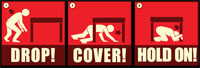
    Your TO DO: Register for the ShakeOut and practice DROP, COVER, and HOLD ON.

    During the drill (or whenever it is appropriate for your schedule) practice these 3 simple steps.
    • DROP to the ground (before the earthquake drops you!),
    • Take COVER by getting under a sturdy desk or table, and
    • HOLD ON to it until the shaking stops.
    For more info on Drop, Cover, and Hold On, see http://www.dropcoverholdon.org/


    See the link below for specifics on what to do depending on your location (indoors vs. outdoors), in the car, on the street, etc. http://www.earthquakecountry.info/dropcoverholdon/

    Friday, September 9, 2011

    Let there be light

    Last night was especially dark for 1.4 million residents of San Diego, Orange County, Arizona, and Northern Mexico who were left without power.   While some enjoyed star-gazing and the excuse to abandon the computer screen, others dodged cars traveling home without street lights, and cowered down pitch-black apartment hallways for their door.  (I may be speaking from personal experience). 
    For many it was a look at how ill-prepared we are for a real emergency. Try the following suggestions to avoid getting left in the dark in the future.  
    Your TO-DO:  Have light sources in each of the following locations. 
    In the car:
    -          Stash a flashlight with one set of extra batteries in your glove compartment.  Bonus: A full size Maglite is an intimidating deterrent and useful in case of car trouble.  LED versions available. http://www.maglite.com/productline.asp

    *Tip: Consider stashing a clip-on flashing bike light should you need to walk for help.
    At work:
    -          Keep a light at your desk or work station.  Many facilities have emergency lights triggered by power outages, but don’t rely on them.  The more light the better should you need to evacuate the building.

    *Tip: Strive for LED lighting wherever possible. Their lifespan exceeds incandescent bulbs by thousands of hours. Find out why: http://electronics.howstuffworks.com/led/htm
    At home
    -        The flashlight suggestions above apply here as well
    -          A bulk package of tea lights can cost a little as 6¢/candle.  Spread them about your home on fireproof surfaces to offer plenty of light.  Store your candles in an easily accessible place with a lighter or a box of waterproof matches.  Extinguish all unattended flames.
    -          Consider a light-weight, portable battery powered lantern that can illuminate a main room.

    *Bonus:  A lantern is a dual investment for your camping supplies!  Keep extra batteries in your 72 hr. kit so it's usable after hours of cards and s'mores at the campground.  
    Out and about:
    -          Keep a small light in your purse, backpack, or on your key ring. 

    *Personal Experience: The local University’s library shuts off its lights and elevators 15 minutes before closing to evict over-achieving students.  2am during Finals Week, a happy meal light-up toy saved me from leaving my laptop cord in a dark group-study room.  Who knew that white elephant gift would come in so handy?
    Discounted Lighting:

    Disclaimer of Endorsement: Reference herein to any specific commercial products, process, or service by trade name, trademark, manufacturer, links, or otherwise, does not necessarily constitute or imply its endorsement, recommendation, or favoring by the author of this blog. They are merely suggestions to familiarize the reader with available product options. The views and opinions of authors expressed herein shall not be used for advertising or product endorsement purposes.


    Sunday, September 4, 2011

    Let me see some I.D.

    Ever had your wallet stolen? No?  Here's what you're missing:
    1. A search for the phone numbers to cancel your credit cards. (Wasn't that written on the back of your now missing card? Great...)
    2. A trip to the bank for a new debit card.  Sigh.
    3. An hour of waiting at the DMV - if you're lucky - for a temporary Driver's License.  Shell out an additional $25 for your replacement.   
    Preempt Murphy’s Law by having photocopies of your wallet’s contents, and other key documents in your emergency kit should you need to recover your wallet or evacuate your home. 
     
    Your To Do: Include copies of the following in a sealed gallon zip-lock bag in your 72 hr. kit:
    • ID/Drivers License
    • Passport
    • Credit/Debit Cards (back and front)
    • Health Insurance Cards
    • Prescriptions (medication and eye glasses)
    • Immunization/Medical Records
    • Professional Certificates or Licenses (RN, MD, JD, EMT)

    Congratulate yourself on the grief and inconvenience saved by 5 minutes of work and 10 photocopies.

    Sunday, August 28, 2011

    Alert San Diego - Emergency Notifications

    Wouldn't it be nice to get the latest information on wild fires, evacuations, tsumnami warnings, etc. should a natural disaster hit San Diego? 
    The City of San Diego has the capacity to send disaster notifications via telephone and email to the residents and businesses of San Diego County.  The program uses the 9-1-1 registry provided by local telephone companies for listed and unlisted land lines.

    Your To-Do: Many of us don't even have land lines anymore, or aren't home enough that it's our primary phone.  Sign up your cell phone and email at  
    http://www.sdcounty.ca.gov/oes/ready/signup.html

    It's just one more thing that makes living in San Diego so fabulous.

    Water - A Critical Component


    Don't count on running to the grocery store for the bottled stuff before or immediately following a disaster.  You need 8 oz. a day minimum to live, not to mention water needs regarding sanitation. Save yourself the grief, and follow the advice on water below.

    The 411: 4 liters or 1 gallon/person/day is the minimum recommendation. Get three gallons for your personal 72 hr kit.
    • Buy it: Purchase bottled water and store in its original container.  2.5 gallon jugs with spouts are particularly convenient.  Only a few dollars at your local grocery store.
    OR
    • Contain it: Reuse clean food grade PETE plastic containers.  2 liter plastic soda bottles are excellent. Avoid plastic milk jugs, cartons, or any containers that have held milk or juices. 
    1. Clean containers first with dishwashing soap and water to remove residue. 
    2. Sanitize all surfaces with bleach solution. (1 tsp bleach /quart of H2O)  Swish solution to make contact with the entire interior of the container, including the cap. Rinse thoroughly,
    3. Fill with clean water, seal, and date the bottle.
    • Store it: Store water in cool, dark place, away from heat sources and chemicals.  Choose a place where a leak will not cause damage to your home.
    • Drink it: Worried about the aftertaste of stored water?  Refill containers every 6 months, or designate older water for sanitation purposes vs. drinking water.  Before drinking, pour water back and forth between two containers to aerate and improve the taste.